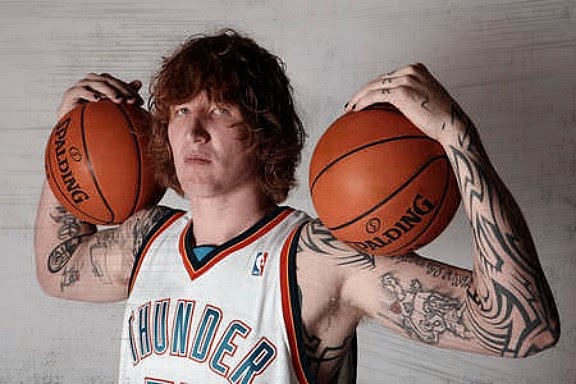
Showing posts with label Robert Swift. Show all posts

Wednesday, July 22, 2015

Jeremy Tyler: Across the Universe


Jeremy Tyler recently wrapped up an engagement with the Dallas Mavericks summer league squad. At 24, the 6'11" basketball nomad has been with 11 pro organizations and counting.

He's hoping this gig will lead to something more permanent.

Tyler was once a famous phenom, a player who jumped the gun way too early. Not only did he skip college but his senior year at San Diego High as well. At the time, the 17-year-old decided the best path to the NBA was through European pro ball—it would take just a couple years to reach that pesky minimum age requirement imposed by David Stern.

The precocious prodigy was counseled in this regard by his father James Tyler, sneaker huckster Sonny Vaccaro, and agent Arn Tellem, then of the Wasserman Media Group.

“This hopefully will turn out to be one of the great life lessons for Jeremy,” Tellem said per Pete Thamel of the New York Times.

That was back in 2009 but it seems much longer ago. That was when Tyler was being described by NBA veteran Olden Polynice as a young Hakeem Olajuwon, and as “one of those guys who comes along once in a lifetime.”

That was when Polynice described the young protégé as being “pimped.”

Jeremy’s plan was to go overseas and come back a star. He’d become the top overall pick in the draft, shake Stern’s hand on stage, make $200 million over a glorious basketball career and then segue into modeling.

But the trans-continental divide didn’t quite work the way Vaccaro had pitched it to the high school dropout. Tyler’s first team was Maccabi Haifa in Israel where he butted heads with tough veteran players and a head coach with no time for coddling.

The teenager was benched, disciplined and lectured. He responded with complaints and accusations. And he played just 10 games before quitting and returning home to San Diego.

Vaccaro was nonplussed, saying per ESPN: “It would’ve been beautiful, utopia, if he had played and helped his team win a championship."

Tyler’s older and wiser now, a tough, solid player who averaged 11.8 points and 8.3 rebounds per game in Las Vegas. He has learned the tricks of the trade during his globetrotting years. Perhaps Tellem was right, but it wasn’t just one grand epiphany.

Back in San Diego, Tyler examined his options—no high school diploma and no longer eligible for college ball after signing a $140,000 pro contract. And he wouldn’t be draft legal for another full year.

But he still had Vaccaro in his corner. The godfather of the sneaker wars hooked Tyler up with Tokyo Apache, a Japanese basketball team that had just been purchased by a Los Angeles-based investor group led by Evolution Capital Management.

Tyler’s dream was still alive, he’d just get made in Japan.

The new head coach of Tokyo Apache was Bob Hill, a seasoned basketball operative from both the college and pro ranks, including the Indiana Pacers, San Antonio Spurs and Seattle SuperSonics. Bob and his son Casey had been working out prospects for their new venture in Dallas. It was now July, 2010, and the Hills had a reclamation project they would partner Tyler with—Robert Swift who would ultimately become a junkie with a stocking over his head in Gold Bar, Washington. But that hadn’t yet happened.

Swift had been another teenage cautionary tale, drafted at 18 out of Bakersfield High in California before Stern had instituted his age limit. Like Tyler, Swift had been repped by Tellem.

By the time Tokyo Apache happened, the 7-foot Swift had played parts of four seasons with the SuperSonics and the Oklahoma City Thunder. He had wrecked his knee more than once, picked up some nasty habits and scorched all his bridges. Hill had been one of Swift’s coaches in Seattle.

Things didn’t start well for either Tyler or his new mentor in Tokyo. Swift was holed up in his downtown apartment, drinking himself into oblivion. And Tyler, who was still not privy to certain basketball fundamentals, was being ripped a new one at practice by Hill.

But things turned around with interventions and tough love. Swift stopped drinking, turned 25 and began collecting double-doubles. He was also relating well with Tyler who was now 19, and starting to figure out how the game should be played. The universe was coming back into alignment.

“Being in Japan is amazing, especially in Tokyo,” Tyler said per Christopher Johnson of the Times. “Everybody is so positive, my coaches, my teammates. There are so many different things to explore here. Basketball is taking care of itself.”


But on March 11, 2011, a massive earthquake shifted the earth on its axis and caused a tsunami that washed out entire cities. In the aftermath, Tokyo Apache disbanded—their L.A. investors decided it just wasn’t worth the hassle anymore.

That was the end if basketball for Swift whose life spiraled into heroin and minor crime sprees. But for Tyler, there was still hope—he was finally eligible for the NBA draft.

He returned home again, convinced there was still salvation to be claimed. And to the surprise of many, the basketball exile began snaking his way up the draft board with the gift of gab.

Per Scott Howard-Cooper of NBA.com: "In interviews with team executives,Tyler has shown himself to be more than a perceived ungrounded basketball soul wandering the globe in search of the next start, and has impressed clubs with his maturity and ability to address his image—even spinning his tangled past into a positive."

Just days before the draft, there were rumors that Tyler could be a fringe lottery pick. But on the night of June 23, those hopes failed to materialize. Perhaps there was simply too much baggage, too many missteps. Tyler slipped out of the first round and was ultimately selected at No. 39 by the Charlotte Bobcats and immediately traded to the Golden State Warriors for cash.

It wasn’t exactly the dream he’d been peddled as a high school junior, but Tyler was now in the NBA—maybe.

The 2011 lockout began a week after the draft and lasted until December. Summer twitterdom and media opinions turned in on themselves like dogs chasing their own tails. And when a shortened season finally got underway, the Warriors found themselves in transition under new head coach Mark Jackson.

It was the beginning of something good for Golden State but it was still a choppy ride—Stephen Curry played just 26 games with ankle issues and the team wound up going 23-43.

As for Tyler, he played 42 games with the Warriors, starting 23 of them but averaging only 13.5 minutes per game. His stat line of 4.9 points and 3.3 rebounds during his rookie season still remains his high water mark in the NBA. He was also assigned to the Dakota Wizards in the D-League on multiple occasions.

Despite the low numbers, Tyler was improving. His starts came toward the end of the season on a team decimated by injuries. In the last game of his rookie campaign, he played 44 minutes and delivered a career-high 16 points, plus nine boards.

The team even put together a brief “swagger and power” clip of the rookie’s highlights.


But the following season Tyler only averaged 1.1 point over 20 games for Golden State, along with more D-League assignments—the Wizards had by now moved west and become the Santa Cruz Warriors. And more changes were still in store.

Right before the February deadline, Tyler was traded to the Atlanta Hawks for future draft considerations. It was nothing more than a cost-cutting move—owners Joe Lacob and Peter Guber wanted to get under the luxury tax ceiling. And whatever portion was left of Tyler’s second round minimum rookie contract, was enough to do the trick.

The onetime high school sensation played exactly one game in Atlanta before getting waived. Tyler was becoming a nonstory.

He appeared with the New York Knicks summer league team in 2013 and was signed in the fall before suffering a stress foot fracture that required surgery. He was subsequently cut to make room for J.R. Smith’s brother and signed by the Knick’s D-League affiliate, the Erie Bayhawks.

Tyler was brought back in late December by New York, playing 41 games for a team that had reached its nadir, featuring the endless death march of head coach Mike Woodson.

Zen master Phil Jackson took over basketball operations in March. Tyler was excited about new opportunities. He studied up on the Triangle offense, feeling that its inside-out nature could benefit his game. He listened in April as Jackson addressed his players in an impromptu group meeting. And when summer arrived and Derek Fisher was hired, Tyler praised the new coach’s leadership.

“Everyone is following his plan,” Tyler said of Fisher during summer league in July. “Everybody respects his system of the Triangle. Even off the court I’ve been replaying different sets in my mind.”

But Tyler was traded to the Sacramento Kings a month later and immediately waived. He managed a training camp invite with the Los Angeles Lakers who were coming off a train wreck season and about to embark upon one that would be even worse. Tyler lasted three preseason games before getting the axe.

Images of broken light which dance before me like a million eyes, they call me on and on across the universe.

The NBA washout did what anyone still chasing the dream would do—he headed to the People’s Republic of China. And there in an ancient mountainous province, he played basketball for Shanxi Zhongyu and a roster of Chinese nationals…plus Von Wafer.

Tyler was a star in Asia once again. He was living in the large industrial city of Taiyuan and took in the outlying sights—massive crumbling Buddhist statues and cliff-hanging temples. But this northern region isn't particularly suitable for tourism in the cold winter months, Mostly, Tyler practiced, played and enjoyed the hospitality of his hosts.  


The Shanxi Brave Dragons finished their season by losing on the road in the CBA quarter-finals to the Quindao DoubleStar Eagles. The game deconstructed in its latter stages, with the tempestuous Von Wafer kneeing an opposing player in the family jewels before tossing a chair into the stands.

Not to be outdone, Tyler got into a fight with Iranian man-mountain Hamed Haddadi and later deigned the giant’s act of contrition—matters escalated into a full-scale hallway rumble replete with security forces and ongoing Brave Dragon/DoubleStar Eagle skirmishes.

Another basketball season was over.

***

During the first week of summer free agency, DeAndre Jordan fled the Los Angeles Clippers for greener pastures, feted by select organizations before agreeing to terms with the Dallas Mavericks. Owner Mark Cuban went all in on the endeavor, according second-choice waiting status to Tyson Chandler who promptly signed with the Phoenix Suns.

But Jordan changed his mind after nearly a week of being a de facto Mav, leaving Dallas conspicuously lacking at the pivot.

A couple years back, Cuban blogged about the capricious nature of free agency and his penchant for seeing something in retread players who had failed in other organizations or systems. “I like our ability to work with what I call 'fallen angels.'"

How can a man who has been mentored by Robert Swift, engaged in fisticuffs with Haddadi, and failed to launch a $200 million career, not be a fallen angel? Tyler rebelled against the Basketball Gods and was cast out time and again. He has chased the rainbow, worked on his craft, become a father and played in every hoops system known to mankind—all by an age at which some prospects are just getting started.

Jeremy Tyler’s greatest sin wasn’t in listening to influencers. It was daring to be a teenager. Sure, he made a mess of things, like a kid with an electric guitar—just take some time and learn how to play.

But while sports is generally big on redemption stories, there is also a coded structure—a beginning and a middle and an ending. And if you take too much time getting to the hook, all is lost.'

Maybe Cuban will play the smart business angle, filling a hole with a minimum salary deal. And maybe a kid once bound for glory will knuckle down in Texas and finally deliver on his much-delayed promise.

But NBA training camps are still months away and professional basketball has increasingly become a year-round globalized business.

For Tyler, the great life lessons continue, across the universe.


Sunday, January 11, 2015

Robert Swift Longform: Leaving Bakersfield


My brother once emptied a clip at his apartment door—someone was trying to break it down from the outside. Both parties lived to see another day, until they didn’t. This is par for the course for heroin addicts. It is not a lifestyle destined for longevity.

When I read the latest news about Robert Swift—the onetime center for the Seattle SuperSonics and Oklahoma City Thunder—it seemed like the logical next drop-step for a basketball curiosity. Because downward spirals are not complicated patterns. The personalities might be, but not the slide itself—it’s just a sucking hole and it is rarely denied.

The former NBA prospect pleaded not guilty on weapons charges in a Seattle courtroom Monday. He was arrested January 6, in the town of Gold Bar, along with 28-year-old Carlos Abraham Anderson. The inept duo were apparently attempting to rob a home in broad daylight.

As Shari Ireton of the Snohomish County Sheriff’s Office recounted: “I believe there were a couple of people who called in, they saw masked subjects on the property, reported that at least one of them was armed with a weapon, one possibly with a baseball bat. It appeared they were either trying to make an entry or knocking on the door.”

Gold Bar, Washington—pop. 2,075—began its existence as a prospectors’ camp in 1889 but more recently faced bankruptcy. Swift, a 7’1” heavily inked-up dude who averaged 4.3 points per game over an injury-plagued five-year career in the NBA, earned about $9.8 million as a pro baller. He went broke a long time ago.

At the time of his arrest, Swift had an outstanding warrant for failure to appear in court the day after Thanksgiving. The admitted junkie had initially been arrested October 4, during a SWAT raid, and was charged with possession of a sawed-off shotgun, along with a grenade launcher and several other firearms on or under his bed.

Also arrested in the ATF-led operation was his roommate and owner of the house, Trgve Bjorkstam. Known as “Trigg,” the 54-year-old was booked for illegal firearms and dealing heroin within 100 yards of the Hellen Keller Elementary School in Kirkland. Other items confiscated included methamphetamine, meth pipes, used needles, a blackened fry pan with heroin residue, and dozens of weapons, some fitted with suppressors.

During their search, agents also discovered a hidden underground bunker initially used to grow weed before being turned into a firing range.

According to police reports, Trigg said that the former hoopster was just a “good guy” who was trying to help him collect on a heroin debt. There are yet no indications whether the more recent botched robbery was in any way connected.

***

East Bakersfield is a fairly typical inland community—desert heat, strip malls and ranch-style houses. Swift grew up as a tall, gangly white kid, with a younger sister, Samantha, now 22, a brother Alex, 28, and parents Bruce, 52, and Rhonda, 59. Robert’s dad was an air conditioning repair man who didn’t work for a few years following a car crash. His mom was dealing with cancer and seven surgeries. There wasn’t always enough food on the table.

Swift was 6’4” by the time he entered junior high. He did what super-tall skinny kids usually do and began playing basketball. He got pretty good too, good enough to go to the MacDonald's All American Game, good enough to attract the favor of AAU leeches armed with promises. Good enough for his parents to encourage pursuing a straight shot from high school to the NBA.


His high school coach suggested the college path instead. “His body was so frail and if you are seven feet tall at 16, your body has some growing to do,” said Gino Lacava during an interview with the UK Daily Mail. “That NBA schedule is rigorous and it doesn’t take much to hurt you. Me and the other coaches were all thinking the same thing, that Robert had definitely nothing to lose by going to college for a few years.”

But Swift’s parents, described as “middle class at best” by Lacava, had dollar signs in their eyes. “They got tied in with these AAU coaches who were constantly throwing around free offers and shoes and all the money and I think to them…it seemed like free money.”

For Swift, a quiet kid who averaged 20 points, 11 rebounds and eight blocks per game as a senior, there was the dream of getting lots of tats, and throwing parties and buying cars. His coaches almost won out though—Swift committed to playing for USC and Henry Bibby.

But his father hired Arn Tellem at SFX and USC went out the window. Heading into the draft, Tellem took an unusual approach. Robert wouldn’t attend predraft workouts, wouldn’t talk to teams, wouldn’t take physicals and wouldn’t attend the Chicago combine. In fact, he wouldn’t even be in New York City on draft night.

The sports agent didn’t want his client’s weaknesses exposed.

Bruce revealed the plan at the time, per ESPN: "His daily routine is to hang out with his buddies and get into some open gyms, shoot a bit, play against local guys here in Bakersfield."

Absence made the hungry hearts of NBA teams grow fonder—the skinny kid from the high desert began zooming up draft boards. On June 24, 2004, he was selected as the 12th overall pick by the Sonics.

The Swift family soon left Bakersfield, courtesy of an 18-year-old meal ticket in a custom pinstripe suit. Their ship had finally come in and the timing couldn’t have been better—Bruce had filed for bankruptcy in 1999 and again in 2003.

That summer trip may have been the best part of what would ultimately become Robert Swift’s long losing streak.

He earned $1.6 million for his rookie season, minus agent commission, taxes and other sundry expenses. He leased a Cadillac Escalade EXT pickup with a 3,500-watt sound system and bought his parents a pair of new SUVS for Christmas. He also bought them a home in Seattle’s upscale Sammamish suburb. And he rented himself an apartment near the team’s facility and started growing his hair and acquiring tattoos.

He didn’t play much basketball, though. Nate McMillan was the head coach at the time and had little patience for the new teenaged center—the paint was already packed with Jerome James, Danny Fortson, Vitaly Potapenko, and Nick Collison who had been drafted the year before but sat out his rookie season with injuries.

McMillan banished Swift to the weight room and told him to bulk up. The kid complied dutifully and also got more tats, threw parties for local college kids, began collecting guns and visited his family a few times a week. When the team went out on the road, Swift’s dad would usually tag along. Bruce never held a job during his son’s time in the NBA.

During his rookie season, Swift averaged 0.9 points and 0.3 rebounds in 4.5 minutes per game, over 16 games.

McMillan left after 19 years with the Sonics organization in order to join the Portland Trail Blazers. Bob Weiss was promoted from assistant coach to head coach for all of 17 games and was then fired. Bob Hill—the man with the year-round tan—was the next Sonics assistant to take over the lead chair.

Hill saw something in Swift and began giving him floor time. He also showed him tough love and tried preparing him for a career in basketball and life beyond.

Jayson Jenks for the Seattle Times wrote about Swift’s flameout and the relationship he built with Hill. During summer workouts, the 19-year-old gushed about a Dodge pickup he had just purchased.

“Robert, I don’t give a (expletive) what your truck looks like or what you drive,” said Hill. “I’m more concerned about making you better here so you can get another contract and maybe another, so by the age of 28 or 29 you can be finished in life. That’s my concern. Not your truck.”

Those words would ultimately be prophetic, although not in the way Hill had hoped.

Swift played his best basketball in the NBA that season, starting 20 out of 47 games and averaging 6.4 points, 5.6 rebounds and 1.2 blocks per game. He had improved his strength and his footwork, could hold his own in the post and had a nice feathery touch on mid-range jumpers, converting 50 percent of his shots from 10-to-16 feet.

The Sonics renewed Swift’s contract for his third season. Hill was planning on making the 20-year-old his starting center for the 2006-07 season. Swift even purchased his own house that July in Sammamish—a sprawling four-bedroom home valued at $1.3 million. Life was starting to look pretty rosy.

But during the preseason, Swift dived out of bounds for a loose ball and tore his right ACL. He wound up missing the entire season. For all intents and purposes, Swift’s NBA career was over but it would take a couple more years for the final nail to be driven into his basketball coffin.

Swift gained weight during his year off, got more tattoos and partied hard at his new mansion. Hill was fired over the phone at the end of the season, after a 31-51 record and failing to make the playoffs for the second year in a row.

The Sonics exercised their option to bring Swift back for another season. He tried making a comeback under new head coach PJ Carlesimo but appeared in only eight games before wrecking his knee again.

The Seattle franchise had been going through their own painful transition since changing ownership from Starbucks founder Howard Schultz in 2006. The team eventually relocated to Oklahoma City as the Thunder, leaving longtime fans in the Pacific Northwest with a bitter taste.

In July of 2008, Swift signed a qualifying offer with the Thunder for $3.6 million. It was a bump up from his previous salary by nearly a million bucks, and would make him a restricted free agent the following spring. It would also allow a draft bust who had played just 71 games in four years, one last opportunity to make good.

The kid from Bakersfield was now 22 years old. He was big and had a body covered in black ink, and had begun painting his fingernails black as well. He was lugging a bulky knee brace up and down the court, but had also dedicated himself to losing weight. He was used sparingly—playing spot minutes for a few games, sitting out a lot more.

Swift averaged 3.3 points and 3.4 boards in 26 games his final NBA season. Carlesimo was fired after going 1-12, and Scott Brooks took over. It was a team heading in a new direction, and that direction would not include a redheaded center who had once been compared to Bill Walton.

Swift was now a free agent and without a paycheck for the first time since high school. He played for the Boston Celtics in summer league action, averaging seven points and 3.6 boards over five games. Danny Ainge had once coveted the teen prospect and had promised to pick him at No. 15 in the 2004 draft. But Seattle got there first.

Summer league ended without an offer and Swift returned to his eastside home in the Seattle outskirts. He began drinking heavily and getting high again. He put the weight back on, plus some. He wandered down to Bakersfield that fall and began hanging out with old friends.

Swift decided to give his hometown another try. In December, he signed with the Bakersfield Jam in the D-League. But after just two games he headed back to Seattle, citing personal issues with his family. The former lottery pick had also just learned his girlfriend was pregnant.


In July of 2010, Bob Hill was with his son Casey in Dallas, working out some prospects. Hill had just landed a job coaching Tokyo Apache. The Japanese pro basketball team first formed in 2004, had been purchased in June by a Los Angeles-based investor group led by Evolution Capital Management.

Hill contacted Swift, and wanted to know if he’d like to play some ball again. The season would begin in September. Swift grabbed at the chance for some semblance of redemption and was also intrigued by the setting—his paternal grandmother was Japanese. He booked a flight to Texas and arrived weighing 335 pounds and sporting a Mohawk.

He told Bob and Casey he’d get a haircut and lose the weight. He’d get right.

But when the season began in Japan, Swift had trouble adjusting. He’d lost 70 pounds of mostly water weight but hadn’t gotten his timing or his confidence back yet. There were things that were bothering him.

According to Jenks and the Seattle Times, Bob and Casey walked into the troubled center’s darkened Japanese apartment in December. He was alone and hung over in bed, an empty vodka bottle nearby. His fiancé had phoned to call off their engagement.

Bob Hill told Swift to get out of bed and read him the riot act: “Maybe being drafted at the age of 18 wasn’t fair. Maybe making all that money at that age wasn’t the right thing for you. But it happened and you have to deal with all this. You’re going to have to plant your feet on the ground and take control of your life.”

Swift began to cry. And then he began putting himself back together. He stopped drinking and worked on his game. He turned 25 and began collecting double-doubles—something that had occurred only twice during his entire time in the NBA. He also mentored 19-year-old Jeremy Tyler—another cautionary tale who skipped college.

The transformation was so dramatic that NBA scouts started calling. The Celtics and New York Knicks wanted to bring Swift in for workouts when his season was done. Hill said it was fun to watch somebody turning their life around.

On March 11, 2011, a massive 9.0 earthquake occurred in the Pacific Ocean, 231 miles northeast of Tokyo. The shock was so big that it shifted the earth on its axis and caused 130-foot waves, including a tsunami that washed out entire cities.

That was the end of the basketball season for Tokyo Apache, and for their existence altogether. The L.A. investors decided it just wasn’t worth it and scuttled the enterprise.

***

Swift returned to his home in Sammamish. In April, he worked out for the Portland Trail Blazers. A brief YouTube video of a tall, slim ginger with a wispy beard shooting jumpers may be the last known basketball footage of the former McDonald’s All-American.

On July 1, 2011, the NBA went on a lockout. It lasted five long months. It wasn’t a good time for a basketball reclamation project to be wishing for a job.

Instead, he started putting harm in his arm and stopped paying the mortgage on his house. Nearly $10 million had slipped away over the years. It would take another 12 months before the bank finally foreclosed on the property.

Swift began shutting down and shutting people out—people like Bob and Casey Hill, like his old coach Lacava, like childhood friends from Bakersfield, and even some members of his own family.

In text exchanges with the UK Daily Mail, Robert’s mother said she hadn’t spoken to him in years, adding: “He bought and did things for his dad and sister but not for his brother or me.”

She also mentioned a book she was writing that would “tell the whole truth.” Because a tell-all book deal will certainly explain how parents helped a multimillion dollar meal ticket grow into a broke heroin addict with a bunch of guns under his bed.

The foreclosure on the house in Sammamish wasn’t a quick and tidy affair. Swift, who owed more than $160,000 in back payments did not want to leave his home. He just wanted to be left alone—with his friends and his dogs and a girlfriend, and his gun collection and various cars in the yard including an El Camino without an engine.

And so he became a squatter in the house he bought with NBA money and then that became the Robert Swift story—for another nine months. He stayed there even after a young couple bought the house at 50 cents on the dollar in January of 2013.

Once the media outlets got hold of the story, little bits of information became malleable. The former draft bust became “Seattle’s basketball savior” and the $10 million he earned turned into $20 million. One local news anchor with a stentorian voice described Swift as the “No. 1 overall draft pick.”

And everybody wanted to know how it came to this.

The nice young couple tried calling Swift and writing letters and knocking on the door of the house they now owned but couldn’t move into. They hired a lawyer and filed legal charges and did TV interviews. News crews tried peeking in the windows.

And finally, one weekend at the beginning of March, Swift and his girlfriend and their dogs were gone. But they left almost all their belongings behind.

The nice young couple rolled in a giant dumpster almost as tall as the house and invited a news crew to come and film. And they wrinkled their noses at the filth as the cameras rolled.

“A lovely way somebody lives,” said the young husband. "The first thing you get when you walk in the door is kind of whiff of whatever is festering in here,” said the young wife.

But what else were they supposed to do? They paid their money just as Swift had paid his. And they wanted to fill their new house with things they had purchased, just as the onetime basketball prospect had done.

The TV footage and the photo galleries from mainstream outlets to basketball blogs showed a myriad of images and some were shown more frequently than others.

There were guns and bullets and empty shell casings. There were bullet holes in the walls and windows and foundation. An article mentioned 100 pizza boxes and 1,000 beer and liquor bottles. Did somebody actually take the time to count?

The empties included dozens of cardboard 18-packs of Coors Light, and there was Mountain Dew and Coca Cola and Twister Tea as well. And cupcakes squashed on the granite kitchen breakfast bar, and outside there were blackened hot dog buns by the grill. There were beds and clothes and a bathroom with blow dryers and toothpaste, and a towel on the vanity that looked like it had simply been used and left before someone headed out for the day—as if they might be coming back later. There was a pool table and computers and stereo equipment, and speakers that once pumped out music, loud and strong. And board games and a model of a covered wagon and a large fishing net and a graveyard of remote controls. The basement had been turned into a firing range and the deck was a place for dogs to poop.

And then there were the photographs of an all-too-short NBA career, and photos of Bakersfield. And a box of letters from colleges with scholarship offers. And outside was a brightly painted basketball court that unlike the interior of the house, seemed oddly clean and well-cared for.

After Swift left, and the dumpster got filled to overflowing, the stories began to recede into the background. Few people seemed to know or care where a washout had wandered off to. Casey Hill said the last he heard, the former basketball player was working as a salesman somewhere in Seattle.

Eight months passed and another NBA draft came and went, as did another summer league. And a new NBA season began and there were new draft busts to write about.

And then the stories came flooding back. A guy who admitted to doing heroin every day got popped in a drug den 100 feet away from an elementary school and didn’t show up for his hearing. And a month later he turned up in a small town that had fallen off the map.

How do you end a downfall story about a homeless seven-foot junkie who decides to put a stocking over his head and knock on someone’s door in Gold Bar?

With a convenient tag about hope for brighter days ahead, or an improbable return to a profession that never quite worked out? Swift’s basketball career didn’t have to end when the earth shifted on its axis and a giant wave hit the Japanese coastline.

He could have played for dozens of other teams that provide refuge and employment for NBA outcasts. But a house and guns and dogs and pizza boxes, and bindles of heroin, were infinitely warmer and easier.


By the time Swift was arraigned on possession of a sawed-off shotgun Monday, he looked frailer than any time since high school. He is being represented by the King County department that works with indigent defendants. His next court date will be January 26.

Ultimately, we look at stories through the lens of our own existence, and sometimes seminal journeys and family memories. Like a string of bullet holes stitched in an apartment door, left by someone who died long ago.

This one is for you my brother.


                                                                                                                    (updated 1/12/15)