Showing posts with label NBA. Show all posts

Wednesday, December 16, 2020

Into the Unknown, Again


For all of the slow-motion, frustratingly lonely and tragic dumpster fires of 2020, there has been a deceptively fast and infinitely welcome lead-up to the new and now current NBA season. Yes, exiguous readers, it’s here and now and will soon burgeon past preseason play to the real enchilada.

The futility of attempting yet another sporadic reboot of a dormant basketball blog is painfully clear. Its moment slipped away long ago, summers of a decade past seem ever more distant now. In 2010, Phil Jackson was beginning his final year as the Lakers’ head coach and Slava Medvedenko was three years out of the league. I wrote about anything and everything under the guise of hoops, from my dog Otis—gone these many years—to the Sages, also long gone. I used a black format with a white font during the portal’s nascent days.

I wanted to make it personal. And, I wanted it to be read. Oh, how I’d plant my links on other sites’ comment pages, or laboriously ping to the far corners of the earth with search engines that no longer exist. Independent basketball journals were flourishing then and the culture felt more connected. Or perhaps it still is and I no longer am.

This past season was uniquely interrupted, truncated and endlessly analyzed. It came to an end after 96 days in the Walt Disney World Bubble. The confetti dropped and piped-in noise ratcheted up to a banshee wail. Pixilated spectator images laughed and cried, affixed to a stretch of giant screens, as players celebrated on the court below in an oddly juxtaposed yet somehow endearing semblance of what was once taken for normal. The Los Angeles Lakers were crowned World Champions after ten long years. And suddenly the grand experiment was over, players and coaches and staff heading home like astronauts returning from a space oddity to a world that must have felt very different and strange. Left behind was an army of health workers packing up their test kits, steam cleaners advancing across garish hotel carpets, cooks and servers, security guards and shipping clerks, invisible camera operators and digital technicians packing massive equipment bags and leaving en-masse. And the memories of player vlogs, when those were what we had to acclimate to a strange new world.

A couple months have passed and once again, we’re heading into the unknown. Training camp is shorter and somewhat later, with two preseason games played to date and another looming on Wednesday. The Lakers are back in their own environment, both the UCLA Health Training Center in El Segundo and Staples downtown. But if anything, it can seem even weirder—a carefully crafted capsule that was nearly akin to a video game in structure has been replaced by cavernous and nearly empty sports arenas that have not been adjusted to scale. The punctiliously controlled Disney setting was remarkably free from a deadly contagion that flared back and forth across the outside nation, spreading in the simplest and most organic of ways—human contact and interaction. Now, the NBA will try its best to contain things on the fly, as teams hit the road again, albeit in a structured and complicated format intended to minimize travel and exposure, and best deduced by swiping a slide rule across a PDF printout.

The team also went through changes during a compressed NBA draft/free agency period, with Danny Green, Avery Bradley, Rajon Rondo, Dwight Howard and JaVale McGee exiting stage left, and Marc Gasol, Montrezl Harrell, Dennis Schröder, Wesley Matthews and Alfonzo McKinnie arriving stage right. All-in-all, a decent haul, augmented by the respective extension and re-signing of megastars LeBron James and Anthony Davis, and the retention/re-signing of the remainder of last season’s supporting cast.

Among the early storylines were a double beat-down of the Los Angeles Clippers as James and Davis rested, with new players impressing on alternate nights, including sophomore Talen Horton-Tucker going supernova like the next Big Thing. Last year’s No. 46 draft pick resembles a human fire hydrant with extraordinarily long gadget arms and legs, a preternatural savvy and the chops to play both ends of the floor with a grounded ferocity that belies his age and experience. On the second of two nights, the 20-year-old from the Windy City dropped 33 points, 10 boards, four dimes and four steals, matching up against the likes of Kawhi Leonard and Paul George. At this rate he’ll be stealing thunder from fan favorite Alex Caruso, which is just fine—they both possess a team-first grind mentality that leaves room for all and all for one.

Despite the sum of the Lakers’ star power, depth and found-again championship swag, we can’t yet foresee how the impending season will play out. This is true under the most stable of circumstances and it is doubly indubitable with the vagaries of the Covid-19 era. Thirty teams along with their accompanying personnel structures, are now in wholly different environments compared to the novel summer bubble. Throw in new players, shortened conditioning regimes and the potential for injury—a constant bugaboo for ballers under the best of circumstances—and the prospect for change in any number of ways increases exponentially.

Still, it has been evident through just two exhibitions, that this is a mature squad that benefits from veteran leadership both on the floor and on the sidelines. Management and the coaching staff deserve more than a brief nod, and if this latest web restart persists beyond the immediate moment, that nod might turn to outright headbanging. Perhaps Frank Vogel can take an existential trip to Flathead Lake, and a meeting of the minds with the ZenMaster among the juniper and pine, the wild roses and brittle fern. Until then, these 1,000 words will serve as yet another bookmark in an oft-interrupted journey that began with the quixotic search for a Ukrainian power forward who vanished as unexpectedly as he appeared, a quest more figurative than literal.  

You say you know but you don’t know, unceasing change turns the circle of life and you can return to a place but not a place in time. Don’t forget to keep your head warm this winter, the lights are still flickering at Searching for Slava.


Friday, June 12, 2020

NBA 2020 Season 2: The Starting Line is Thataways?


Anyone possessing a basketball pulse should know by now that the NBA will likely resume its 2019-2020 basketball season in a self-sustaining bubble community known as the ESPN Wide World of Sports at Disney World, Florida, beginning with practices and scrimmages, and progressing to a reboot of competitive play sometime around July 30. By the time teams battle each other again for supremacy—assuming the magic ship doesn’t sail off the rails again due to rising cases of Covid-19 and contentious union negotiations—approximately four months and 20 days will have passed since things came to a screeching halt. With eight seeding games per team in a 16-day period followed by four rounds of a traditional best-of-seven playoff format, the new schedule will stretch out until about October 13. As welcome as this all is, it seems a bit ridiculous to refer to a novel concept as anything resembling the resumption of the regular season. Instead, let’s call it NBA 2020 Season 2, and assume that what we’re currently in qualifies as the preseason. There’s plenty to sort through during this waiting period, although the more important strokes will ultimately be left to historians to wrestle with. Basketball is only a small portion of it, part of the parcel, a footnote, a diversion, a necessity for some, an addiction, welcome solace, a thing to think about late at night when all is dark and sleep comes slowly and uneasily, when stresses and isolation and social inequities and survival all swirl together in a new normal that is anything but normal in any sense of the word. Remember when we took it all for granted? Remember when choices seemed simpler, even if there is nothing simple about the world we now inhabit?

The year was less than a month old when Kobe Bryant and eight other precious souls were lost in a fiery crash, a cataclysmic event that threw more than just the sports world into shocked disbelief and grieving. It was so sudden, so strange. It put us all into a shell-shocked stew of question marks and reminisces. We struggled to come up with words, but we all wanted to make words, and to relive and recount memories. Even as all that was unfolding, early news of Wuhan, China and the wariness of an uncontainable contagion had been seeping into our collective consciousness, and it wouldn’t be long before we were all asking, or at least thinking, about the where and when of a larger spread. By the time of the inevitable cessation of NBA play, our thoughts were not so much a result of surprise, but the inevitability we all knew or suspected. Matters only mushroomed from there, in each and every facet of life.

The rapid proliferation of a lethal disease came at us in waves, a sea of tragedy compounded by sheer ineptitude and negligence at the highest levels of the federal government, embodied by a petulant and narcissistic loaf of a man with an incongruous blonde up-and-over swirl of hair offset by an orange spray tan and pale piggish eyes. If there happens to be an insulted reader or two out of a scant handful that still pays any attention to a microblog that’s way past any imagined prime, that’s okay—I don’t give two fucks at this point. We’re three and a half years into a Category 5 shit storm of non-leadership, ripped from any norms of governance that still exist, with no standing left among nations we once held as allies, and with even less at home. But months of sickness, death and a shattered economic collapse from coronavirus wouldn’t deprive other societal disorders of their needed oxygen, case in point being the slithering rot of white nationalism spoon-fed by Dear Leader to fear mongers and blunderers, aggressors and dog whistlers, slack jaw feeders, bleaters and red coal carpet creepers. A steady stream of protectionism, harassment, brutality and murder amalgamated like a freeway pileup during a pandemic that had already rubbed a nation raw, culminating with an eight-minute, forty-six-second asphyxiation of George Floyd by a white cop who was so fucking nonchalant about a public execution that he actually kept his hands in his pockets while kneeling on the man’s neck, like a golfer lining up his next putt on a flawless green. That policeman and his three cohorts uncorked a levee that has been threatening to breech for a very long time. We don’t know where the surging tide will lead—it’s righteous hurt and anger, a human shapeshifter, purpose and peace, visible from space on 16th Street.

Sports is not a panacea for all that ails us, but it’s an endeavor that deals with success and failure, domination and disintegration. It can be inspiring and frustrating, unifying and dividing and whatever other words you want to toss into the bubbling stew, but I sure as hell would be okay watching a high-arcing shot from way downtown hitting nothing but net right around now. It has also become a late-night diversion that begins with rewatching NBA games from earlier in the season on a mobile device, and proceeds toward vain attempts to lull myself to sleep by imagining exactly what this sports experiment will actually look like. There have been all kinds of rumors and tidbits about the possibility of not having actual on-site play-by-play and color commentators, perhaps using drone cameras and positioning remote analysts in studios safely removed from the action, or even more confounding, the notion that head coaches over the age of 65 might not be allowed to roam the sidelines. That’s not gonna fly. There’s also news of a faction of players holding conference calls to debate the sustainability of playing in the Disney bubble and you can’t blame them for asking or wondering, given the volatility of the situation on the ground, as well as the optics of a league largely made up of black men being sequestered to entertain the masses. I have loads and loads of questions, like what will it be like for athletes to train and compete on an obstacle course that has never existed before, what will the viewing experience be like for an audience, and whether fans will be replaced by cardboard cutouts perched on blacked-out bleachers with subtle backlighting and ambient noise from an NBA 2K20 soundtrack? Where will the players live, what will they eat, what teams will advance and what’s the weather like in that neck of the woods in August anyway? I’m assuming high-90s and constant humidity that feels like a hot, wet towel draped across the face. Plus mosquitos the size of mutant bats.

I find myself with a lot of time on my hands these days. I’m not exactly hermetically sealed off in an alternative timeline but I do find myself staring at the screen a lot. I’m not sure whether up is down or down is up. I go to sleep later and I wake up later and I’m not entirely convinced that dreams are any less real than reality. The never-never land is a fragmented journey to get somewhere but the finish line is forever changing. References to the upcoming basketball reboot inevitably use Orlando as a key word but the resort is actually in Bay Lake, a city that was incorporated 53 years ago yet still only has a population of 51. The 23 square mile municipality is owned and controlled by the Walt Disney Company and its original residents were relocated a long, long time ago. These days, the only permanent townspeople live off the grid in a tiny cluster of mobile homes, surrounded by thick stands of pine trees and bodies of water. These hand-picked good folks are supposedly there to keep the cogs of bureaucracy running when it comes to matters such as land use and planning, but in truth, they mostly just live there, paying $75 a month in rent and watching the bobcats and manatees play. These aren’t your day-to-day Disney World employees tasked with actual nuts and bolts jobs at the theme parks, such as cashiering, food service and frolicking in brightly-colored tunics. Those people are uniformly referred to as Cast Members, and live in different residential communities where their rent is automatically deducted from electronic pay deposits. Regardless, it’s all part of Orange County, Florida, where coronavirus numbers are rapidly spiking upwards, even as the state continues on track to a full reopening. You can insulate a reboot of the National Basketball League all you want, but somebody’s got to serve Woody’s Box Lunches to hungry athletes. And at some point, the ripple effect of flag-draped boat rallies and 55 Other Best Things to Do in Orlando is going to make itself known. I could go on for a couple thousand more words but I won't. Which way was the starting line again?

Monday, March 16, 2020

Our Collective Kid


How can you begin to write about a season upended, of sickness and panic and utter strangeness, stemming from a microscopic piece of genetic material taking its first uncertain toddler steps before exploding into a dead run? The enormity of the entire NBA closing down over the course of an evening was juxtaposed with the ever-growing and sobering reality of local, national and global events, swarming our senses like a giant cloud of locusts. As days passed, a larger reality of societal shutdown began to dwarf a game in which two opposing teams—with no more and no less than five players each at any one time—advance an inflated ball from one end to the other and then back again, in hopes of putting that cylindrical object through a metal hoop ten feet off the ground. That magical portal is composed of high tensile carbon steel, draped in nylon netting. It is a transcendental thing, the be-all, end-all culmination of great effort, of sprinting, pounding, dribbling and passing, of blocks and rebounds, misses and curses, slips and tumbles and taunts, of elbows and teeth and whistles, of stops and starts and leaping and soaring, crashing and burning, layups and jams, of hanging on the same steel circle as its supporting structure sways and strains precipitously. This is the place where the netting dances, almost silently, as a full-grain leather orb completes its perfect rainbow arc from somewhere downtown, swishing through a split second before the roar of the crowd climbs over 100 decibels, louder than a freight train thundering past, and mingling ever so perfectly with the incandescent blur of LED lighting powerful enough to melt the average cornea. It's the place where spirits soar and fall, where pure joy happens, where drinks are sloshed and relationships begin and end. And a game that can be akin to a scorching solo or a perfect choir, that is both objective and unabashedly opinionated, and one played and observed from inches to miles and miles away, is suddenly silenced.

“Shut the light, go away. Full of grace, you cover your face.”

The NBA did what it had to do. And all the shuttering, the social distancing and hoarded goods and claustrophobia, the unanswered questions and staring at screens doesn’t begin to compare to the larger losses and suffering around a globe that we all knew was in some kind of trouble waiting to happen. We just didn’t know exactly what, even with warning signs all around, even with all that we read and hear and consume and ignore. I want a moment back in time, to make dinner and grab a beer out of the fridge, to turn on the warming rays and sit on the couch, to sit and grin, to get up and pace and frown and curse, to share the experience on social media, to win or lose, but ultimately, to be absolutely lost in the moment. The beauty of these shared experiences—sports or otherwise—is that even when the season draws to its inevitable close, there’s always the security of knowing that it will roll around again, that the year is broken up into segments that are part and parcel of an unbroken picture. It’s all changed now, we’re emptying shelves and straining to see—specks in our eyes, we were dropping like flies.

Time passes imperceptibly and the path begins its gradual ascent, a late afternoon sun bouncing off canyon walls. A thousand dimpled footprints from a time gone by. Hawks drift lazily on thermal banks, a contrail arcs across the azure sky. Somewhere, a skillet is sizzling, hunks of onion curl and wine burbles slowly from a dark bottle’s neck. Pings of music echo from a distance away and lights are slowly crackling to life. We want our moments back.

“I think I know, some things we never outgrow.”


Lyrics from "Kid"/Pretenders/C. Hynde

Wednesday, April 13, 2016

Remember when Kobe was here?


Somebody recently asked about my favorite Kobe Bryant moment of all time. I couldn’t come up with one. The thousands of games and tens of thousands of plays within all those games have somehow formed into composites—an athlete performing mind-boggling feats under washes of light and accompanied by a screaming sound chorus, moments that become isolated on sports shows and augmented by camera pans and time-altered effects until they simply become part of an ever-changing narrative. 

Glory, defeat, shame, redemption, injury, recovery, debate, the bloom of youth to the inevitability of age, from his rookie year to this—hours before his final game with the Los Angeles Lakers.

I haven’t written much about Bryant this season. I can’t begin to explain why, except that it is some form of avoidance. And a rationale that if everyone else is doing it, there is no need for me to. What could I possibly add to that vast lexicon?

During training camp I contemplated a story that would take place in the present while imagining the future—one without the man. The idea that he has touched so many people in so many different ways, and a vacuum that could have a more lasting impact than some might imagine.

But I couldn’t really wrap my head around it all. Instead, I simply looked at box scores and read the commentary. I winced at the truly awful games and took small pleasures in those rare moments when a guy who should be in a wheelchair managed some approximation of the greatness he once was.

And a season slipped by.

He has outlasted several generations of players when you consider the professional lifespan of an average NBA hoopster is 4.8 years. Bryant’s two decades have not only put him into the fringes of uncharted territory, but have also resulted in a shifting and evolving attitude toward him, from those who played with him and those who chronicled his career. He has earned the well-deserved reputation of a difficult person to be around.

Fierce, uncompromising, competitive beyond what is acceptable even in the cutthroat world of sports.

In a Nike commercial in which athletes were asked to sum Bryant up in a single word, Kevin Durant said quietly, “asshole.”

There was an implicit respect in the curse. 

Or as his onetime Lakers teammate Steve Nash mused on a different occasion, “a fucking asshole.”

But generational fluxes also play into these dynamics, the take-no-prisoners attitude exhibited toward peers becomes folklore observed by younger athletes growing up, who then become participants themselves.

What always struck me, above anything else, was the degree of difficulty.

Bryant set the bar impossibly high, Icarus flying too close to the sun but tinkering with the mechanics or “the process” as he always called it, in order to somehow avoid melting the wax and feathers. And when his plummet to earth inevitably happened, he took the road back as a Sisyphean challenge—a self-aggrandizing overachiever who pushed a too-large boulder up the hill over and over again, pausing only for ice baths or Orthokine knee treatments in Germany.

The impossible shot selections, the tendency to take over games, the tunnel vision that his way was not only the best but the only way, wasn’t the work of a guitar hero shredding without form or structure. Because his relentless film study, his analytical destruction and reconstruction of all known aspects of the game, recalibrated after each injury and the passing years, seemed to coalesce into airtight arguments, statements of fact and accomplishments so detailed and immense that it just became easier for others to simply give up in the end.

Until the end.

The last time I wrote at any length about Bryant was last summer, acknowledging the futility of adding to a story that has been so thoroughly covered for two decades by imagining what might lie ahead through a fictional construct:

Ask the average person how many articles have been written about Kobe Bryant and you’ll get a blank stare in return. Nobody knows but it is certainly a very high number. It would be like counting the mosaic tiles in the Basilica of San Vitale. 
There are no new angles to explore, there is no new information to report. Past glories have been repeated to death and there are only so many ways to spin predictions for his probably-but-not-absolutely final season of basketball. There can be no criticisms that have not yet been voiced, no chronicling of hero shots that have been launched or death glares cast toward teammates. Or teammates who worship him or those who hate him, or new ones he hasn’t yet met due to a top secret gyrocopter excursion to a mountaintop retreat where he’ll undergo molecular cartilage transfusions in an attempt to grow a new finger in place of that hideous turnip currently attached to his right hand… or left hand.

Twenty years of witnessing a particular player, on television, in person, listening left-to-right on the radio dial while stuck in rush hour traffic on the way home from some job or another. Chick Hearn’s words eye view gave the kind of accompaniment that transformed to actual visual memories years later. Because these are all snippets, brush strokes that form a collective over time. Watching pirate feeds on a shaky dialup connection, commenting with bloggers on long ago threads that no longer exist, bantering on social media with friends from another place in time.

The passing generations were not only the players Bryant encountered and outlasted along the way, they were also the observers and the very methods of observation. The snake is long, 20 miles long.

ESPN’s Baxter Holmes recently wrote a stunningly good piece about the last true days of Bryant. Seven brutal games in which the gift and curse of obsession was on full display, the refusal to rest, the chain reaction of a freeway pileup in order to achieve a cause, leading ultimately to a blown-out Achilles tendon:

It's possible, in retrospect, to see what happened three years ago as something foreshadowed by ominous portents. The last game of Kobe Bryant -- the gladiator Kobe Bryant, the bulletproof, monomaniacal Kobe Bryant -- was full of such moments. But that's how history works. After the fact, everything is clear.

That should have been the final chapter, the ultimate body betrayal and self-destruction after so many wars.

Of course, that wasn’t how it ended. There would be a surgery to reattach the tendon after so many previous surgeries on other body parts, and months of rehabilitation followed rapturously by the media, followed by another season in which he broke his left knee after just six games, with another torturously long recovery period made even longer by all the previous damage done to his body. And that was followed by the Lakers signing Kobe to a new $48.5 million two-year contract. And then he was trotted out once more, only to tear his shoulder, requiring yet another operation.

They shoot horses, don't they?

And finally, one last farewell tour, one that could only have been imagined by the spirits of the underworld. Bryant, his body completely broken, soldiering through the worst season in his team’s entire history. 

But somewhere along the line he finally came to peace with it all. The jaw-jutting anger from years past has been replaced by something we are far less familiar with. He smiles more easily now, laughs off questions he once would have bristled at, talks about gratitude and acceptance. Bryant has managed to hold his body together until the very end, the team leader in points per game, putting up 35 the other night against the Houston Rockets.

And the inescapable fact that he has been a pure joy to watch over these many years. We could still squint our eyes a little and see that guy.

How do you identify a favorite moment? It is elusive and subjective, with only one remaining sliver to grasp at. It is just hours before the final curtain. One more ice bath, the last drive to Staples Center and a gimpy stroll through a tunnel accompanied by cameras and shouted questions.

And then the wash of lights and the swelling sound.

Remember when Kobe was here?


Sunday, January 11, 2015

Robert Swift Longform: Leaving Bakersfield


My brother once emptied a clip at his apartment door—someone was trying to break it down from the outside. Both parties lived to see another day, until they didn’t. This is par for the course for heroin addicts. It is not a lifestyle destined for longevity.

When I read the latest news about Robert Swift—the onetime center for the Seattle SuperSonics and Oklahoma City Thunder—it seemed like the logical next drop-step for a basketball curiosity. Because downward spirals are not complicated patterns. The personalities might be, but not the slide itself—it’s just a sucking hole and it is rarely denied.

The former NBA prospect pleaded not guilty on weapons charges in a Seattle courtroom Monday. He was arrested January 6, in the town of Gold Bar, along with 28-year-old Carlos Abraham Anderson. The inept duo were apparently attempting to rob a home in broad daylight.

As Shari Ireton of the Snohomish County Sheriff’s Office recounted: “I believe there were a couple of people who called in, they saw masked subjects on the property, reported that at least one of them was armed with a weapon, one possibly with a baseball bat. It appeared they were either trying to make an entry or knocking on the door.”

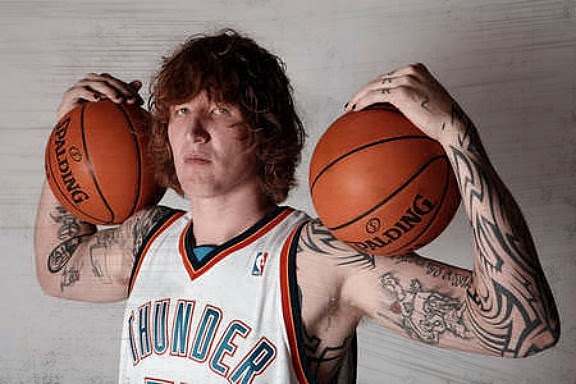
Gold Bar, Washington—pop. 2,075—began its existence as a prospectors’ camp in 1889 but more recently faced bankruptcy. Swift, a 7’1” heavily inked-up dude who averaged 4.3 points per game over an injury-plagued five-year career in the NBA, earned about $9.8 million as a pro baller. He went broke a long time ago.

At the time of his arrest, Swift had an outstanding warrant for failure to appear in court the day after Thanksgiving. The admitted junkie had initially been arrested October 4, during a SWAT raid, and was charged with possession of a sawed-off shotgun, along with a grenade launcher and several other firearms on or under his bed.

Also arrested in the ATF-led operation was his roommate and owner of the house, Trgve Bjorkstam. Known as “Trigg,” the 54-year-old was booked for illegal firearms and dealing heroin within 100 yards of the Hellen Keller Elementary School in Kirkland. Other items confiscated included methamphetamine, meth pipes, used needles, a blackened fry pan with heroin residue, and dozens of weapons, some fitted with suppressors.

During their search, agents also discovered a hidden underground bunker initially used to grow weed before being turned into a firing range.

According to police reports, Trigg said that the former hoopster was just a “good guy” who was trying to help him collect on a heroin debt. There are yet no indications whether the more recent botched robbery was in any way connected.

***

East Bakersfield is a fairly typical inland community—desert heat, strip malls and ranch-style houses. Swift grew up as a tall, gangly white kid, with a younger sister, Samantha, now 22, a brother Alex, 28, and parents Bruce, 52, and Rhonda, 59. Robert’s dad was an air conditioning repair man who didn’t work for a few years following a car crash. His mom was dealing with cancer and seven surgeries. There wasn’t always enough food on the table.

Swift was 6’4” by the time he entered junior high. He did what super-tall skinny kids usually do and began playing basketball. He got pretty good too, good enough to go to the MacDonald's All American Game, good enough to attract the favor of AAU leeches armed with promises. Good enough for his parents to encourage pursuing a straight shot from high school to the NBA.


His high school coach suggested the college path instead. “His body was so frail and if you are seven feet tall at 16, your body has some growing to do,” said Gino Lacava during an interview with the UK Daily Mail. “That NBA schedule is rigorous and it doesn’t take much to hurt you. Me and the other coaches were all thinking the same thing, that Robert had definitely nothing to lose by going to college for a few years.”

But Swift’s parents, described as “middle class at best” by Lacava, had dollar signs in their eyes. “They got tied in with these AAU coaches who were constantly throwing around free offers and shoes and all the money and I think to them…it seemed like free money.”

For Swift, a quiet kid who averaged 20 points, 11 rebounds and eight blocks per game as a senior, there was the dream of getting lots of tats, and throwing parties and buying cars. His coaches almost won out though—Swift committed to playing for USC and Henry Bibby.

But his father hired Arn Tellem at SFX and USC went out the window. Heading into the draft, Tellem took an unusual approach. Robert wouldn’t attend predraft workouts, wouldn’t talk to teams, wouldn’t take physicals and wouldn’t attend the Chicago combine. In fact, he wouldn’t even be in New York City on draft night.

The sports agent didn’t want his client’s weaknesses exposed.

Bruce revealed the plan at the time, per ESPN: "His daily routine is to hang out with his buddies and get into some open gyms, shoot a bit, play against local guys here in Bakersfield."

Absence made the hungry hearts of NBA teams grow fonder—the skinny kid from the high desert began zooming up draft boards. On June 24, 2004, he was selected as the 12th overall pick by the Sonics.

The Swift family soon left Bakersfield, courtesy of an 18-year-old meal ticket in a custom pinstripe suit. Their ship had finally come in and the timing couldn’t have been better—Bruce had filed for bankruptcy in 1999 and again in 2003.

That summer trip may have been the best part of what would ultimately become Robert Swift’s long losing streak.

He earned $1.6 million for his rookie season, minus agent commission, taxes and other sundry expenses. He leased a Cadillac Escalade EXT pickup with a 3,500-watt sound system and bought his parents a pair of new SUVS for Christmas. He also bought them a home in Seattle’s upscale Sammamish suburb. And he rented himself an apartment near the team’s facility and started growing his hair and acquiring tattoos.

He didn’t play much basketball, though. Nate McMillan was the head coach at the time and had little patience for the new teenaged center—the paint was already packed with Jerome James, Danny Fortson, Vitaly Potapenko, and Nick Collison who had been drafted the year before but sat out his rookie season with injuries.

McMillan banished Swift to the weight room and told him to bulk up. The kid complied dutifully and also got more tats, threw parties for local college kids, began collecting guns and visited his family a few times a week. When the team went out on the road, Swift’s dad would usually tag along. Bruce never held a job during his son’s time in the NBA.

During his rookie season, Swift averaged 0.9 points and 0.3 rebounds in 4.5 minutes per game, over 16 games.

McMillan left after 19 years with the Sonics organization in order to join the Portland Trail Blazers. Bob Weiss was promoted from assistant coach to head coach for all of 17 games and was then fired. Bob Hill—the man with the year-round tan—was the next Sonics assistant to take over the lead chair.

Hill saw something in Swift and began giving him floor time. He also showed him tough love and tried preparing him for a career in basketball and life beyond.

Jayson Jenks for the Seattle Times wrote about Swift’s flameout and the relationship he built with Hill. During summer workouts, the 19-year-old gushed about a Dodge pickup he had just purchased.

“Robert, I don’t give a (expletive) what your truck looks like or what you drive,” said Hill. “I’m more concerned about making you better here so you can get another contract and maybe another, so by the age of 28 or 29 you can be finished in life. That’s my concern. Not your truck.”

Those words would ultimately be prophetic, although not in the way Hill had hoped.

Swift played his best basketball in the NBA that season, starting 20 out of 47 games and averaging 6.4 points, 5.6 rebounds and 1.2 blocks per game. He had improved his strength and his footwork, could hold his own in the post and had a nice feathery touch on mid-range jumpers, converting 50 percent of his shots from 10-to-16 feet.

The Sonics renewed Swift’s contract for his third season. Hill was planning on making the 20-year-old his starting center for the 2006-07 season. Swift even purchased his own house that July in Sammamish—a sprawling four-bedroom home valued at $1.3 million. Life was starting to look pretty rosy.

But during the preseason, Swift dived out of bounds for a loose ball and tore his right ACL. He wound up missing the entire season. For all intents and purposes, Swift’s NBA career was over but it would take a couple more years for the final nail to be driven into his basketball coffin.

Swift gained weight during his year off, got more tattoos and partied hard at his new mansion. Hill was fired over the phone at the end of the season, after a 31-51 record and failing to make the playoffs for the second year in a row.

The Sonics exercised their option to bring Swift back for another season. He tried making a comeback under new head coach PJ Carlesimo but appeared in only eight games before wrecking his knee again.

The Seattle franchise had been going through their own painful transition since changing ownership from Starbucks founder Howard Schultz in 2006. The team eventually relocated to Oklahoma City as the Thunder, leaving longtime fans in the Pacific Northwest with a bitter taste.

In July of 2008, Swift signed a qualifying offer with the Thunder for $3.6 million. It was a bump up from his previous salary by nearly a million bucks, and would make him a restricted free agent the following spring. It would also allow a draft bust who had played just 71 games in four years, one last opportunity to make good.

The kid from Bakersfield was now 22 years old. He was big and had a body covered in black ink, and had begun painting his fingernails black as well. He was lugging a bulky knee brace up and down the court, but had also dedicated himself to losing weight. He was used sparingly—playing spot minutes for a few games, sitting out a lot more.

Swift averaged 3.3 points and 3.4 boards in 26 games his final NBA season. Carlesimo was fired after going 1-12, and Scott Brooks took over. It was a team heading in a new direction, and that direction would not include a redheaded center who had once been compared to Bill Walton.

Swift was now a free agent and without a paycheck for the first time since high school. He played for the Boston Celtics in summer league action, averaging seven points and 3.6 boards over five games. Danny Ainge had once coveted the teen prospect and had promised to pick him at No. 15 in the 2004 draft. But Seattle got there first.

Summer league ended without an offer and Swift returned to his eastside home in the Seattle outskirts. He began drinking heavily and getting high again. He put the weight back on, plus some. He wandered down to Bakersfield that fall and began hanging out with old friends.

Swift decided to give his hometown another try. In December, he signed with the Bakersfield Jam in the D-League. But after just two games he headed back to Seattle, citing personal issues with his family. The former lottery pick had also just learned his girlfriend was pregnant.


In July of 2010, Bob Hill was with his son Casey in Dallas, working out some prospects. Hill had just landed a job coaching Tokyo Apache. The Japanese pro basketball team first formed in 2004, had been purchased in June by a Los Angeles-based investor group led by Evolution Capital Management.

Hill contacted Swift, and wanted to know if he’d like to play some ball again. The season would begin in September. Swift grabbed at the chance for some semblance of redemption and was also intrigued by the setting—his paternal grandmother was Japanese. He booked a flight to Texas and arrived weighing 335 pounds and sporting a Mohawk.

He told Bob and Casey he’d get a haircut and lose the weight. He’d get right.

But when the season began in Japan, Swift had trouble adjusting. He’d lost 70 pounds of mostly water weight but hadn’t gotten his timing or his confidence back yet. There were things that were bothering him.

According to Jenks and the Seattle Times, Bob and Casey walked into the troubled center’s darkened Japanese apartment in December. He was alone and hung over in bed, an empty vodka bottle nearby. His fiancĂ© had phoned to call off their engagement.

Bob Hill told Swift to get out of bed and read him the riot act: “Maybe being drafted at the age of 18 wasn’t fair. Maybe making all that money at that age wasn’t the right thing for you. But it happened and you have to deal with all this. You’re going to have to plant your feet on the ground and take control of your life.”

Swift began to cry. And then he began putting himself back together. He stopped drinking and worked on his game. He turned 25 and began collecting double-doubles—something that had occurred only twice during his entire time in the NBA. He also mentored 19-year-old Jeremy Tyler—another cautionary tale who skipped college.

The transformation was so dramatic that NBA scouts started calling. The Celtics and New York Knicks wanted to bring Swift in for workouts when his season was done. Hill said it was fun to watch somebody turning their life around.

On March 11, 2011, a massive 9.0 earthquake occurred in the Pacific Ocean, 231 miles northeast of Tokyo. The shock was so big that it shifted the earth on its axis and caused 130-foot waves, including a tsunami that washed out entire cities.

That was the end of the basketball season for Tokyo Apache, and for their existence altogether. The L.A. investors decided it just wasn’t worth it and scuttled the enterprise.

***

Swift returned to his home in Sammamish. In April, he worked out for the Portland Trail Blazers. A brief YouTube video of a tall, slim ginger with a wispy beard shooting jumpers may be the last known basketball footage of the former McDonald’s All-American.

On July 1, 2011, the NBA went on a lockout. It lasted five long months. It wasn’t a good time for a basketball reclamation project to be wishing for a job.

Instead, he started putting harm in his arm and stopped paying the mortgage on his house. Nearly $10 million had slipped away over the years. It would take another 12 months before the bank finally foreclosed on the property.

Swift began shutting down and shutting people out—people like Bob and Casey Hill, like his old coach Lacava, like childhood friends from Bakersfield, and even some members of his own family.

In text exchanges with the UK Daily Mail, Robert’s mother said she hadn’t spoken to him in years, adding: “He bought and did things for his dad and sister but not for his brother or me.”

She also mentioned a book she was writing that would “tell the whole truth.” Because a tell-all book deal will certainly explain how parents helped a multimillion dollar meal ticket grow into a broke heroin addict with a bunch of guns under his bed.

The foreclosure on the house in Sammamish wasn’t a quick and tidy affair. Swift, who owed more than $160,000 in back payments did not want to leave his home. He just wanted to be left alone—with his friends and his dogs and a girlfriend, and his gun collection and various cars in the yard including an El Camino without an engine.

And so he became a squatter in the house he bought with NBA money and then that became the Robert Swift story—for another nine months. He stayed there even after a young couple bought the house at 50 cents on the dollar in January of 2013.

Once the media outlets got hold of the story, little bits of information became malleable. The former draft bust became “Seattle’s basketball savior” and the $10 million he earned turned into $20 million. One local news anchor with a stentorian voice described Swift as the “No. 1 overall draft pick.”

And everybody wanted to know how it came to this.

The nice young couple tried calling Swift and writing letters and knocking on the door of the house they now owned but couldn’t move into. They hired a lawyer and filed legal charges and did TV interviews. News crews tried peeking in the windows.

And finally, one weekend at the beginning of March, Swift and his girlfriend and their dogs were gone. But they left almost all their belongings behind.

The nice young couple rolled in a giant dumpster almost as tall as the house and invited a news crew to come and film. And they wrinkled their noses at the filth as the cameras rolled.

“A lovely way somebody lives,” said the young husband. "The first thing you get when you walk in the door is kind of whiff of whatever is festering in here,” said the young wife.

But what else were they supposed to do? They paid their money just as Swift had paid his. And they wanted to fill their new house with things they had purchased, just as the onetime basketball prospect had done.

The TV footage and the photo galleries from mainstream outlets to basketball blogs showed a myriad of images and some were shown more frequently than others.

There were guns and bullets and empty shell casings. There were bullet holes in the walls and windows and foundation. An article mentioned 100 pizza boxes and 1,000 beer and liquor bottles. Did somebody actually take the time to count?

The empties included dozens of cardboard 18-packs of Coors Light, and there was Mountain Dew and Coca Cola and Twister Tea as well. And cupcakes squashed on the granite kitchen breakfast bar, and outside there were blackened hot dog buns by the grill. There were beds and clothes and a bathroom with blow dryers and toothpaste, and a towel on the vanity that looked like it had simply been used and left before someone headed out for the day—as if they might be coming back later. There was a pool table and computers and stereo equipment, and speakers that once pumped out music, loud and strong. And board games and a model of a covered wagon and a large fishing net and a graveyard of remote controls. The basement had been turned into a firing range and the deck was a place for dogs to poop.

And then there were the photographs of an all-too-short NBA career, and photos of Bakersfield. And a box of letters from colleges with scholarship offers. And outside was a brightly painted basketball court that unlike the interior of the house, seemed oddly clean and well-cared for.

After Swift left, and the dumpster got filled to overflowing, the stories began to recede into the background. Few people seemed to know or care where a washout had wandered off to. Casey Hill said the last he heard, the former basketball player was working as a salesman somewhere in Seattle.

Eight months passed and another NBA draft came and went, as did another summer league. And a new NBA season began and there were new draft busts to write about.

And then the stories came flooding back. A guy who admitted to doing heroin every day got popped in a drug den 100 feet away from an elementary school and didn’t show up for his hearing. And a month later he turned up in a small town that had fallen off the map.

How do you end a downfall story about a homeless seven-foot junkie who decides to put a stocking over his head and knock on someone’s door in Gold Bar?

With a convenient tag about hope for brighter days ahead, or an improbable return to a profession that never quite worked out? Swift’s basketball career didn’t have to end when the earth shifted on its axis and a giant wave hit the Japanese coastline.

He could have played for dozens of other teams that provide refuge and employment for NBA outcasts. But a house and guns and dogs and pizza boxes, and bindles of heroin, were infinitely warmer and easier.


By the time Swift was arraigned on possession of a sawed-off shotgun Monday, he looked frailer than any time since high school. He is being represented by the King County department that works with indigent defendants. His next court date will be January 26.

Ultimately, we look at stories through the lens of our own existence, and sometimes seminal journeys and family memories. Like a string of bullet holes stitched in an apartment door, left by someone who died long ago.

This one is for you my brother.


                                                                                                                    (updated 1/12/15)


Friday, December 2, 2011

THE BLUE SKY POST


It's been one week since the great abomination ended and it seems much longer. I had thought to chronicle it, but didn't. Last Friday, I stayed up late, tracking yet another negotiating session, the first since the disbanding of the union. It wasn't the legal giants, the men who arch fingers and shape laws and landmarks. Instead, it was the same group that had battled so long and so hard. Minus Jeffrey Kessler.

My head hurt and my throat hurt. Sharp stabbing shards in my temples and the hard lump that makes it a chore to swallow. It was the wee hours and I packed it in, keeping my cell nearby. Only able to sleep in short stretches, feeling someplace out of body. Checking the tiny glowing screen in darkness, periodically. And at some point saw that it had finally ended. And could finally sleep.

I wore a stupid grin all day and exchanged messages and read a flood of accountings – time washed by like an ecstatic blur, white light and clicking keys. But distractions as well, work had rappelled down like an assassin and when the work's there you take it. And days passed with trade rumors and B-issues and I put down thoughts and filed them away and found myself returning to lockout wounds and wondering if you can just flip the switch. And working and typing and the screen goes black. "No operating system found." 

Life can throw all manner of curves. You burn your toast, you discover a new cavity. A sunny day, your laptop crashes. You make a perfectly good piece of toast. Your middle-aged next door neighbor screams at his girlfriend between the hours of three and five AM when you have to get up at six. The cops come at five-thirty. Their red and blue lights throw a charming pattern on your blinds.

Yesterday, NBA gyms around the country opened for business. At the Lakers practice facility in El Segundo, nobody bothered to show. Similar stories at other gyms and again I wondered, do we have the right to expect happy players after five months of ugliness? The owners could have gotten this exact same deal without losing a game, without breaking a sweat. Instead, they made it personal.

Forget about it Dave, it's Chinatown.

There are wild rumors about a trade involving some combination of Andrew Bynum, Pau Gasol and Lamar Odom, for Dwight Howard. This is NBA normalcy. The season is returning. The players signed and scanned their cards and sent them in. The union is reforming. The lockout lasted 149 days. There will come a cold winter night, not long from now, when I'll be staring at a TV screen. Thoughts will go away. Shots will arc high, through a bank of lights. And it will have become the players' league once again.

In early June, I wrote about the uncertainty and the eventual coming of the season – that the clock would reset, the system would restore. It has been raining all day. Over the past hour, my sore throat has finally turned into a full blown cold. I have sneezed a couple dozen times, including on the laptop I borrowed. The neighbor has turned on his music. He's yelling again. My dog's sleeping, oblivious. In the cupboard, there are packets of Theraflu. I'm putting the water on to boil. The season is here again.